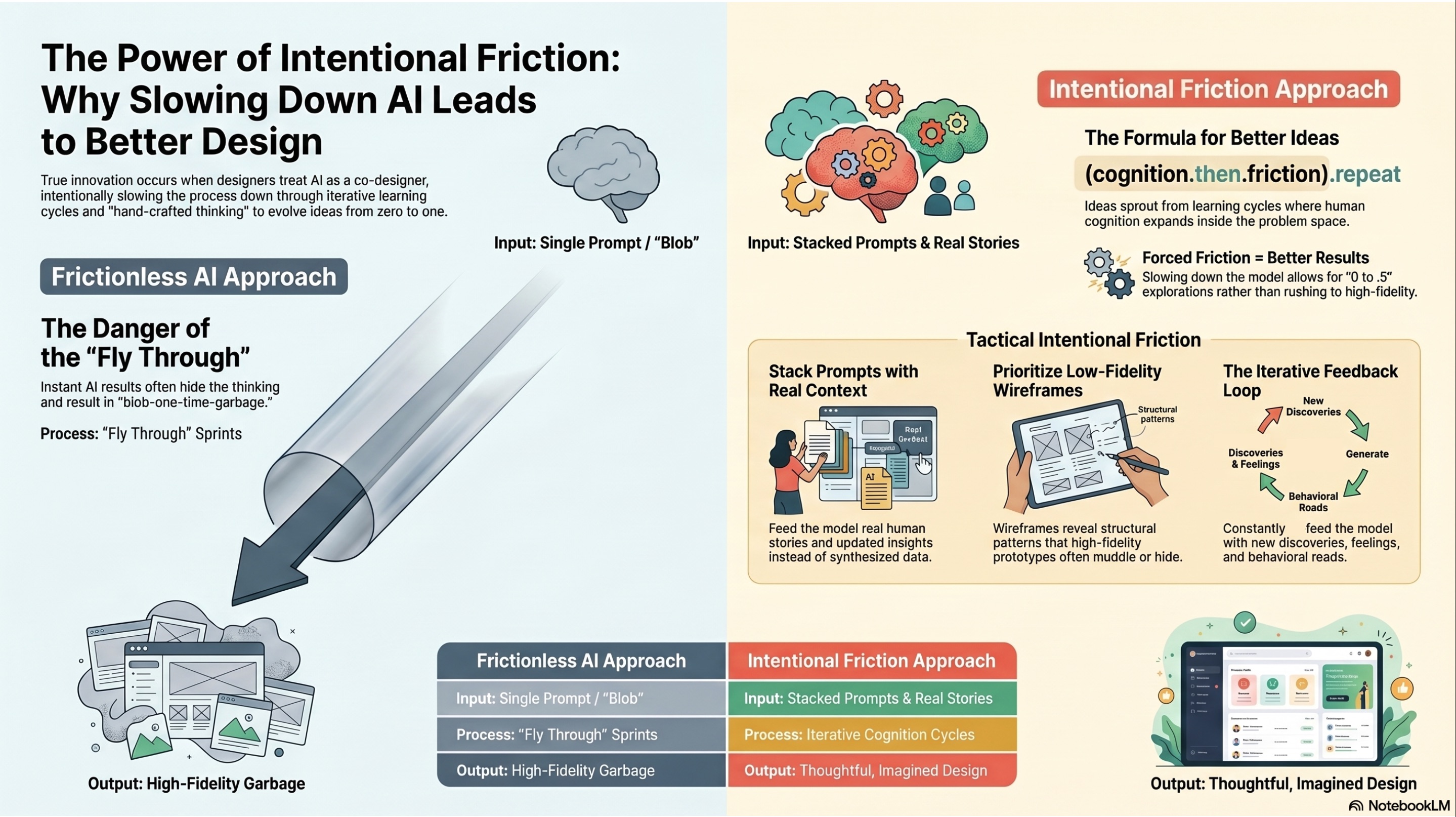
Creating forced-friction will get you better results with Stitch, Claude Design. Break down your zero to one explorations into (0 -> .5)*n explorations.
* follow for daily human-written perspectives.
Whiteboards gave designers, PMs, and engineers a shared canvas to argue on, a common space to find coherence in.
They also slowed the process down.
Cognitively, we, humans, need the friction. That's where we learn. And, the best ideas usually sprout from the learning cycles.
It is not what we know in the beginning of the sprint.
It is what you learn as you progress. Ideas are shape-shifted in realtime as your cognition expands inside the problem space. Sometimes so dramatically, that these first ideas are unrecognisable by the time we are polishing.
This is "where ideas come from": (cognition.then.friction).repeat
People are marvelling at how frictionless a model can run a design sprint, end-to-end. "You just prompt it, but before, you get a good design.md...."
I literally just read: "...and it even created all the personas, then solved the problems for them... ". 👀
Ok. 🤪
People replacing themselves, advocating for it, and being happy about it, is the most interesting human phenomenon of this current cycle. But... back to it.
What these people are missing is that the secret is to NOT ALLOW the fly through.
You must force the model into friction.
The game-changer move is to keep re-feeding the model with discoveries, insights, updated feelings and reads on behaviour, an iterative relationship.
Iterate cognition, and create intentional friction. Slow the model down.
Do this, and you will be the one designer working with Stitch and Claude that is producing results no one else in your team can even imagine how.
Blob-one-time-garbage in, blob-garbage out.
Design thinking in, thoughtful design out. Collaborate with the model as you would with a co-designer. The model was designed to be your collaborative partner, not a shortcut.
- Don't skip on research.
- Don't synthesise human stories. Use real stories as ground truths.
- Stack prompts, so they can benefit from cognitive clarity as the problem space unfolds.
- Don't generate high fidelity prototypes first. They hide the thinking behind the pretty. Yes, wireframes are still useful. They help your brain see patterns that are muddled by high fidelity looks.
- Diverge, learn, prompt for friction (not solution-wishing), iterate.