They say AI killed designers. I say: we are about to see the craft explode. My thesis, and 4 things to (really) monitor if you are a designer 👇 .
* Pardon my humanity, written without 🤖 .
Anyone can now produce a functional landing page or a working dashboard from a prompt.
That's the thesis for the murdering, right?
So, this also means the floor of what a competent product looks like is rising fast, and much of what used to count as differentiation is going with it.
If that's the thesis, what's left to compete on is the quality of the experience itself: whether the interface is clear, whether the flow respects the user's time, whether the hundred small decisions a design team makes add up to something coherent.
In other words: Craft.
This was evidenced also by the State of the Designer 2026, Figma report.
The correlation between good design decisions and growth has been proven by data, many times.
Claims that "Product Design is a middle-layer" are not grounded.
Design is a revenue driver, with solid studies pointing bigger correlations to PMF and growth than any other area.
The data is really clear: Design is the "Product Market Fit" department.
Don't take my word for it.
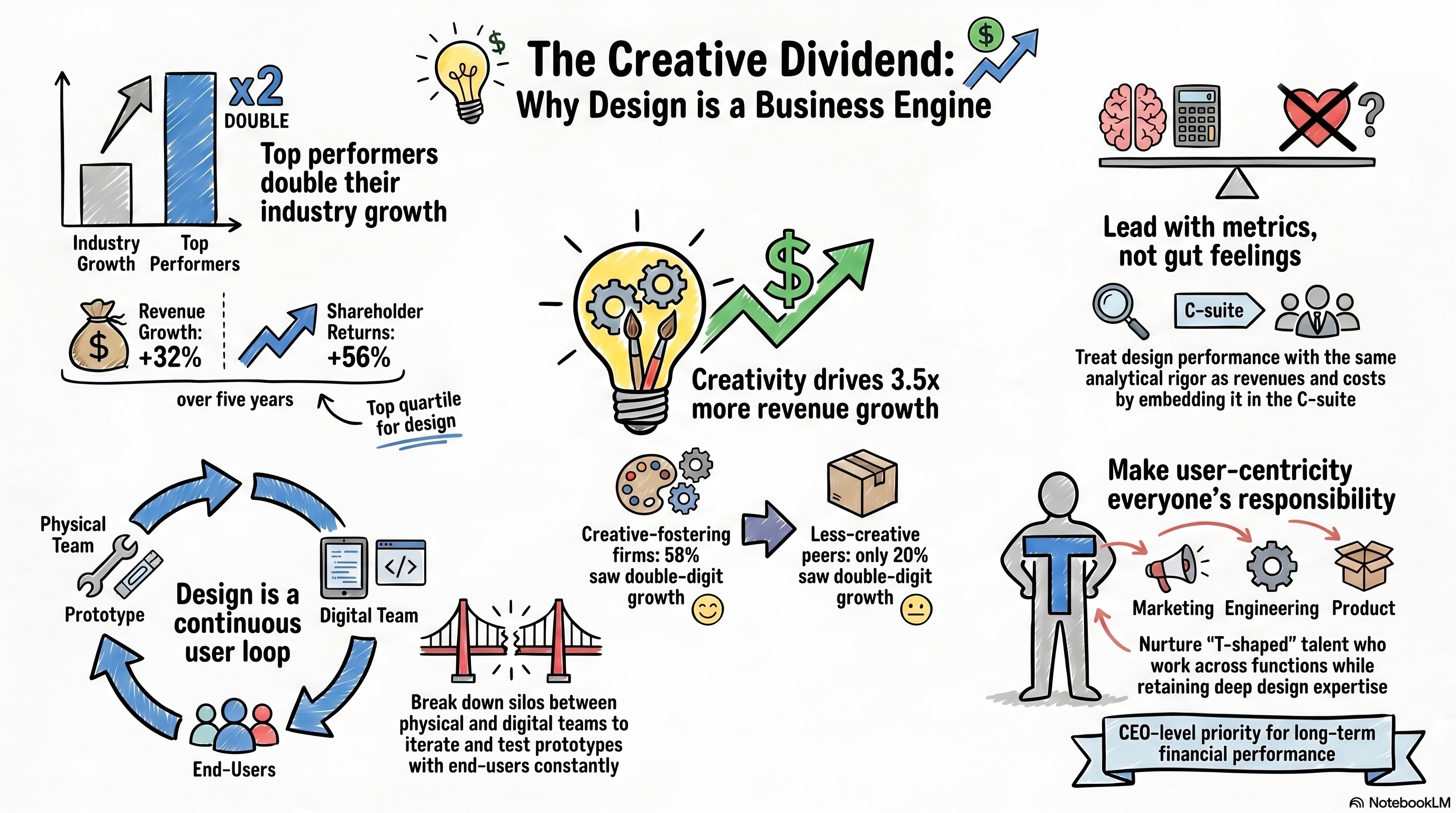
McKinsey's Business Value of Design study, tracked 300 publicly listed companies across medical, tech, consumer goods, and retail banking over five years. More than two million financial data points and more than 100,000 discrete design actions catalogued.
The study is not new, it ran in 2018, but it showed:
- Companies in the top quartile of McKinsey's design index grew revenue 32 percentage points faster than their industry peers over that window.
- Their total returns to shareholders ran 56 points higher.
The gap held across all three industries, which rules out the explanation that design only matters in categories where aesthetics obviously do.
The murderer's chant is mostly based on P&Ls that still treat design as a cost line (headcount, tooling, whether any of it can be offshored).
Thing is, companies doing that were hurting, already.
So, if the thesis is AI killed designers because "they were a middle-layer", the counter is that design was never alive in the ecosystems were it was treated this way, and these companies were paying for it.
What AI has changed is the cost of being on the wrong side of that gap.
The distance between companies investing in good design and the ones that aren't widens faster when everyone can monkey-slap a UI.
AI's will accelerate (GOOD) design adoption, and make the value of the craft clear. Also, in a couple of years, the Augmented Reality application layer will be born. Every application will have to adapt to AR.
That said, the real changes you should monitor as a designer:
- The pipeline changed. (Adapt to it)
- Roles will change. (Re-position)
- Junior designers will take a hit. (Look for growth outside the job)
- Monitor the spatial design space.
*Chart is based on McKinsey's study.